

NHG-Springer’s EcoHealth journal now in its 22nd year of publication.
Nature Health Global is delighted to announce the signing of a 5-year contract with Springer-Nature to manage and publish the peer-reviewed scientific journal EcoHealth. Now the official journal of Nature Health Global, EcoHealth is in its 22nd year of quarterly publication. It was launched in March 2004 by a consortium of institutions and editors interested in the relationship between ecological and health sciences. Over the years it has published key papers on the role of environmental changes in driving emerging disease threats, and an EcoHealth approach to emerging diseases was the focus of 2020 paper in Science. Key papers in the journal have highlighted the critical roles of pollutants and health including indoor smoke pollution, methyl mercury, and atmospheric haze.
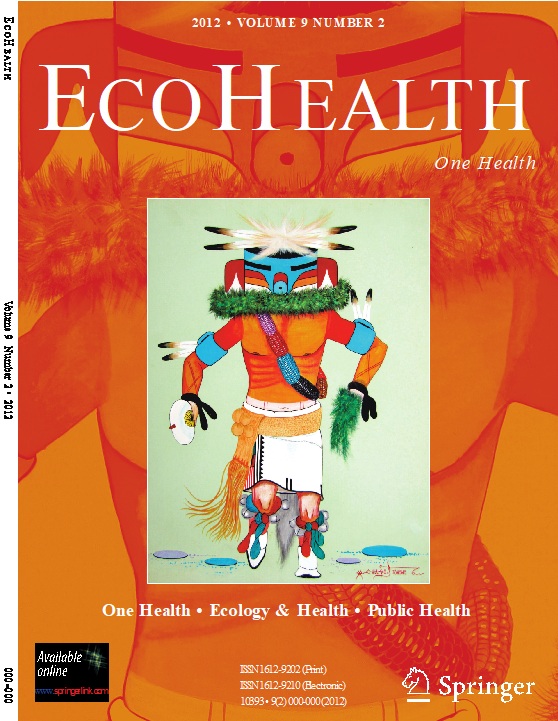
“Corn Kachina” by Michael Chiago, a Tohono O’odham/Pima-Maricopa watercolor artist and illustrator, born in the Kohatk Village on the Tohono O’odham reservation. From EcoHealth Volume 9, issue #2. Cover Essay “Corn, Flour, Blue” by Peter Daszak & Sara E. Howard (https://link.springer.com/journal/10393/volumes-and-issues/9-2)
The journal helped launch the International Association for Ecology and Health (now EcoHealth International), and to expand the fields of One Health, Conservation Medicine, Disease Ecology, Planetary Health, and Global Change Biology. Highly-cited papers on amphibian chytridiomycosis, a fungal disease that has caused global extinctions, have helped demonstrate its origins via wildlife trade and other human introductions. The journal has pushed the cross-disciplinary boundaries, publishing papers by economists working with disease ecologists, vector biologists using ecological approaches to control disease, and mental health practitioners focused on climate change publishing a series of papers on solastalgia.

“Spring has gone” (2009) by Aram L. Kim, etching with aquatint and color pencils. Winner of the EcoHealth 2010 Conference Art Competition. Cover essay “A Beautiful Death” Peter Daszak. EcoHealth 7, 405–407 (2010). https://doi.org/10.1007/s10393-011-0679-9
Over the last 20+ years, the EcoHealth journal has brought a fresh new vision to how science is published, read and incorporated into our culture. “With inspiration from the CDC journal Emerging Infectious Diseases, we pushed from our very first issue to bring art and science together” says NHG’s President and EcoHealth journal Editor-in-Chief, Dr. Peter Daszak. Every issue since volume 1 has carried carefully selected cover art, usually linked to the focus of articles in that issue, and often to a guest essay that helps make the connection between art and science. This led to a long collaboration with the poet Mark Olival-Bartley, and a series of new commissioned poems on disease and health: e.g. “Self Portrait with the Spanish Flu” and “Palladia” which has particular relevance our post-pandemic chaotic world. Note: see the “Gallery” at the end of this article for some of our beautiful covers over the years…

“Danse Macabre 1918” by Robert Warren Harrison (Instagram @RobertWarrenHarrison), from EcoHealth 18, issue #2.
The journal has also focused on the practice of building ecological and health outcomes, with papers on conservation, on community outreach, and on capacity building solutions to health issues. This has been helped by a close connection to the Canadian EcoHealth movement which first coined the term “EcoHealth” for a program at the IDRC/CRDI headed by Jean Lebel and then Dominque Charron. The social science data and qualitative research published by the journal has helped provide the evidence to underpin these actions. The body of work on how science interacts with society has direct relevance to environmental and health policies in the Anthropocene, to the climate changes we will see in the next 50 years, and crucially in our efforts to walk them back. In 2024 Springer announced that over 50% of the articles published in EcoHealth were related to one or more of the 17 Sustainable Development Goals (SDGs).
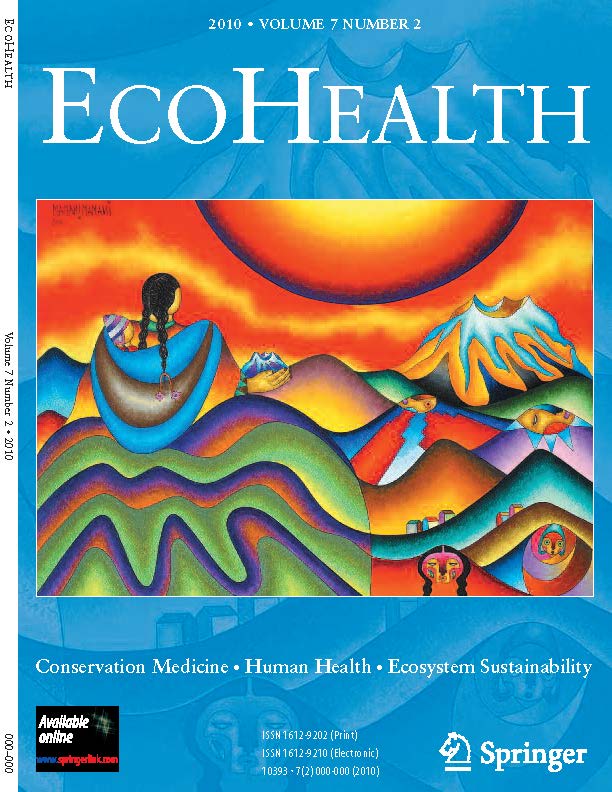
“Madre Illimani con Intis, Awichas y Niños” (2010) by Roberto Mamani Mamani, pastels on paper. Cover Essay “Gleaming power of the Andes, Sapped” by Peter Daszak & Sara E. Howard. EcoHealth 7, 267–268 (2010). https://doi.org/10.1007/s10393-010-0361-7
In the coming months, the EcoHealth journal will revive and expand its commitment to fusing science, art and culture: Each issue will continue to have a work of art on the cover of direct relevance to the science published within the issue. Cover essays that explain the art/science overlap, poetry and prose will be invited to continue building these links. The journal will continue its goals of publishing high quality peer-reviewed science, and to linking the evidence base of science with the practice of conservation, environmental health, ecology and medicine. Crucially, it will continue to provide a forum to discuss geopolitical issues that affect science, environment, health, and vice versa.

“Cormorant fishing” by Guyu An, 2007, Ink on rice paper. Cover essay “Taoism’s Ecological Wisdom and the Flight of the Cormorant”, Peter Daszak, Aleksei A. Chmura, Shangxian Luo, Guiquan Liang & Bruce Wilcox. EcoHealth 5, 235–236 (2008). https://doi.org/10.1007/s10393-008-0182-0
NHG’s President and EcoHealth journal Editor-in-Chief, Dr. Peter Daszak stated that “There is a great deal of uncertainty around science at the moment. Cuts to science funding in the USA, attacks that undermine the public understanding of science, and the promotion of pseudo-science threaten to upend the use of science to explain our world, and determine how we live on this planet. This is exactly why Nature Health Global has made this long-term commitment to publishing peer-reviewed science – the gold-standard for discerning fact from fiction.” He added “We look forward to increasing our journal’s impact, keeping its key focus on the interactions of ecological and health science, and expanding into new, critical fields of research and practice.”
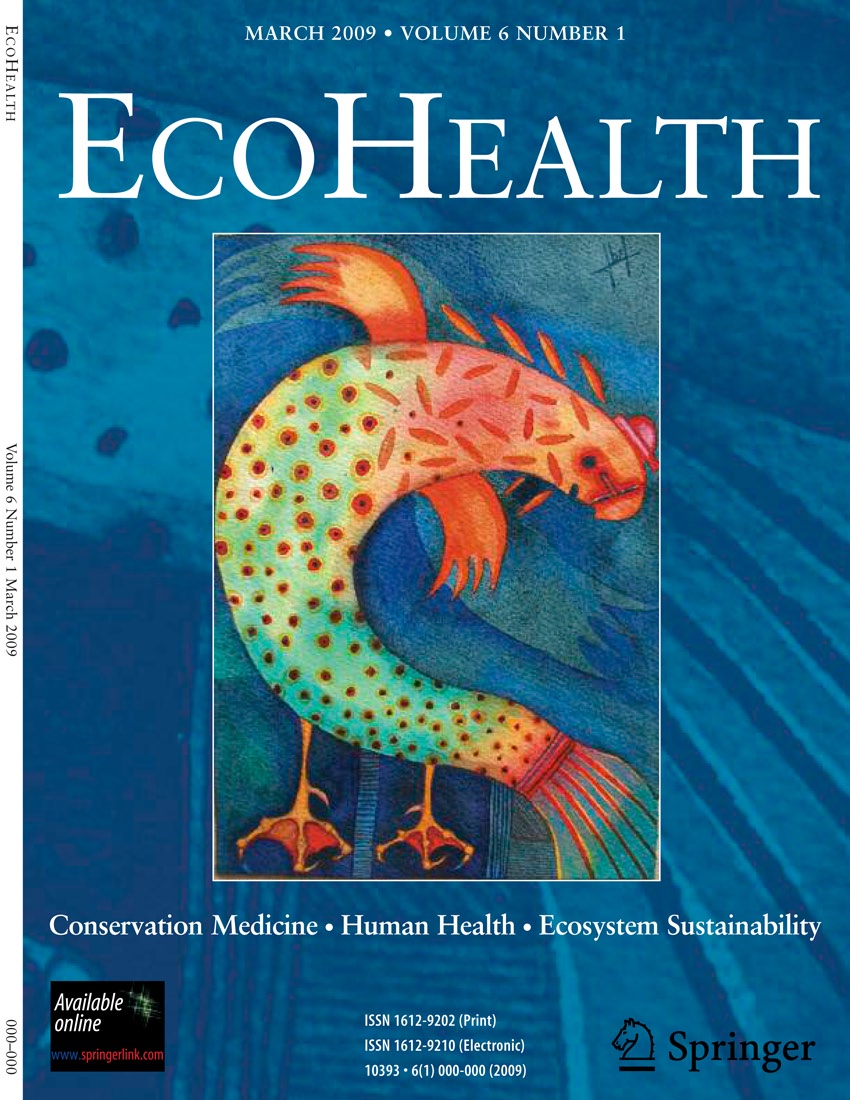
“Pájaro-Alebrije” by Abel Vázquez, watercolor from EcoHealth 6 issue #1. Cover Essay “Rock, Paper, Scissors; Chicken, Human, Swine” Daszak, P., Howard, S.E. & Chmura, A.A. EcoHealth 6, 159–160 (2009). https://doi.org/10.1007/s10393-009-0245-x
Dr. Aleksei Chmura of Nature Health Global, who will continue his role as Managing Editor has already begun the process of expanding the journal’s vision. “We are planning a series of collections, which focus on specific issues and will invite key authors to contribute, the health of our oceans, coastal systems and the people who depend on them for survival. We are announcing a new member of our Executive Editorial Group, Dr. Hung Nguyen from ILRI who will help us bring a new focus on livestock and food production systems. Following the most significant pandemic in the last 100 years, we will also focus on lessons learned about the relationship between largescale health threats, and environmental change”.
Dr. Daszak sums up the enthusiasm at Nature Health Global by commenting: “This journal has a very special connection for me. I was there at the inception and worked for over a year with our Founding Editor-in-Chief Bruce Wilcox to find a publisher and help fund the journal. I’ve spent endless hours working with artists and our artist-in-residence, the poet Mark Olival-Bartley, to show how we can fuse science and art to bring a deeper context to our natural (and unnatural world). I wrote many of the cover essays, and some have deep personal meaning to me. For example, in 2010, to coincide with an IAEH conference in London, UK, we decided to avoid cliché’d images of pastoral England, and instead used a rather miserable painting by L.S. Lowry, of the polluted cemetery outside my hometown of Manchester – the real story of the UK’s EcoHealth journey, summed up in my essay “My Jerusalem, My EcoHell”. Likewise, at our 2016 One Health-EcoHealth conference in Melbourne I had the honor of seeing John Longstaff’s darkly inspirational painting “Arrival of Burke, Wills and King at the deserted camp at Cooper’s Creek, Sunday evening, 21st April 1861” which inspired another EcoHealth cover and an essay on Australia’s checquered history of colonial exploitation of the land and its owners.” Note: you can read some of these Cover Essays and see the Cover Art at the end of this article, below.
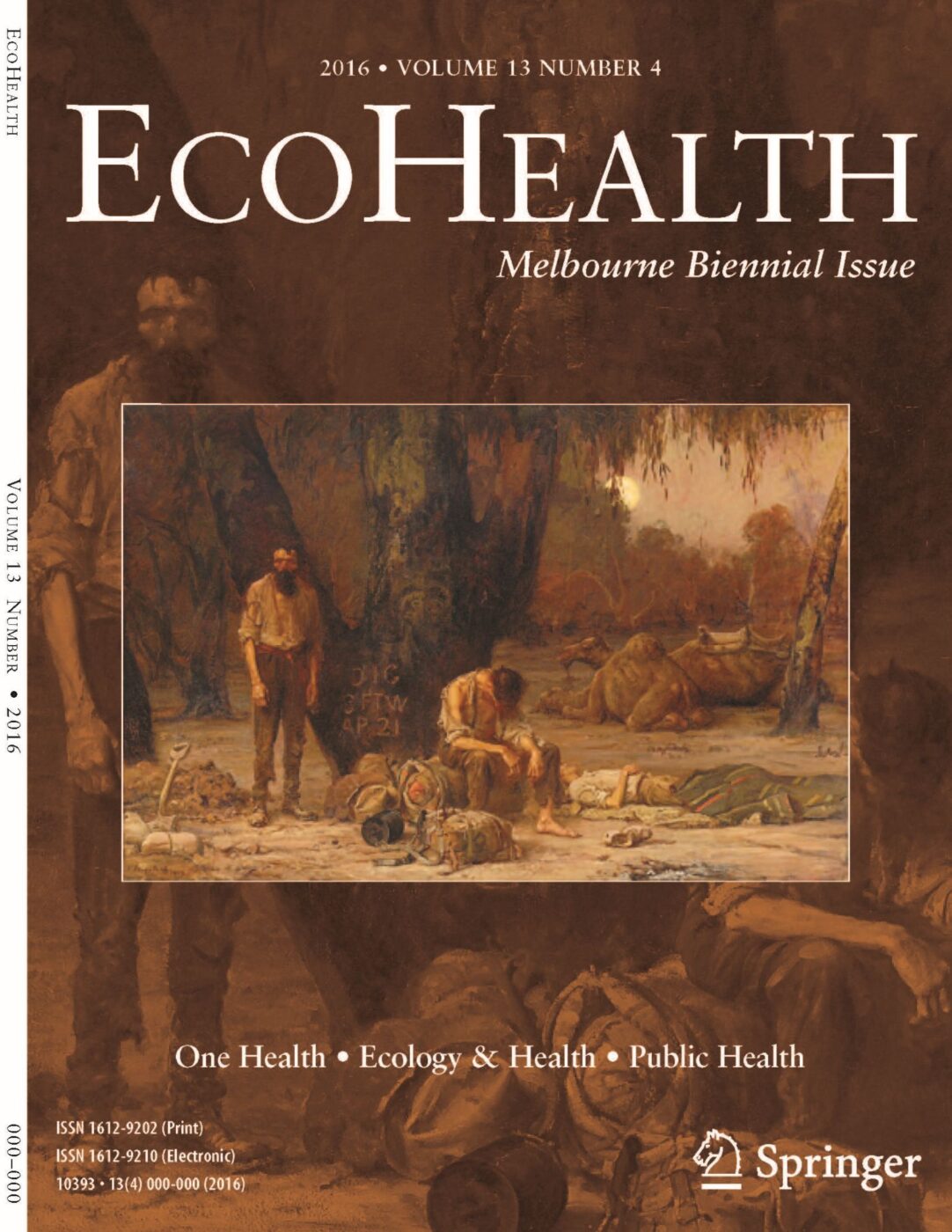
“Arrival of Burke, Wills and King at the deserted camp at Cooper’s Creek Sunday evening, 21st April 1861” by John Longstaff 1907. Oil on canvas. Cover Essay “A Last Waltz for Burke, Wills, and King, by Peter Daszak. EcoHealth 13, 821–823 (2016). https://doi.org/10.1007/s10393-016-1199-4

“Children’s play” by Thàn Chuong (2007), Vietnam. Cover Essay “Whither Goest Thou, Sacred Cow?” by Peter Daszak & Aleksei A. Chmura. EcoHealth 5, 390–391 (2008). https://doi.org/10.1007/s10393-008-0203-z
For further information about Nature Health Global, and the NHG-Springer journal EcoHealth, please visit https://naturehealthglobal.org/, join our mailing list and you’ll get regular updates of news and events.
Some of the Cover Art, Poems and Essays published in EcoHealth
Lucky Country, Broken Land 2009 by Peter Daszak
Australia’s ongoing problems with climate change, drought, wildfire, and agriculture are deeply rooted in its colonial past. In this essay, Peter Daszak draws attention to the irony of the phrase “Lucky Country” – widely used to mark the 1950s and onwards rise of Australia’s geopolitical impact, but actually written as a dry critique of its aggressive domination of the land and its indigenous communities. The essay features a traditional grass painting by Murrwurruwurr (Dennis McCarthy) also cites a Forum piece by Katja Mikhailovich in this issue of the journal focused on drought and water in Australia

“Ginga & Lilies” (2006) by Dennis McCarthy/Murrwurruwur, charcoal and indigenous pigments on canvas. Cover Essay “Lucky Country, Broken Land” by Peter Daszak. EcoHealth 6, 476–478 (2009). https://doi.org/10.1007/s10393-010-0305-2


My Jerusalem, My EcoHell, 2010 by Peter Daszak
Written as the cover essay to coincide with the Biennial meeting of the International Association for Ecology & Health (now EcoHealth International) in London, “My Jerusalem, My EcoHell” provides a personal reflection on biodiversity and health in the UK from the 1970s to the present day. The corresponding journal cover is a fairly dark view of Manchester, UK, by the famous artist L.S. Lowry “The Lake”. The painting, while beautiful and inspirational, is a counterpoint to the rural landscapes, images of the Lake District fells, and optimistic scenes of rural southern England (cf. Constable’s The Hay Wain).
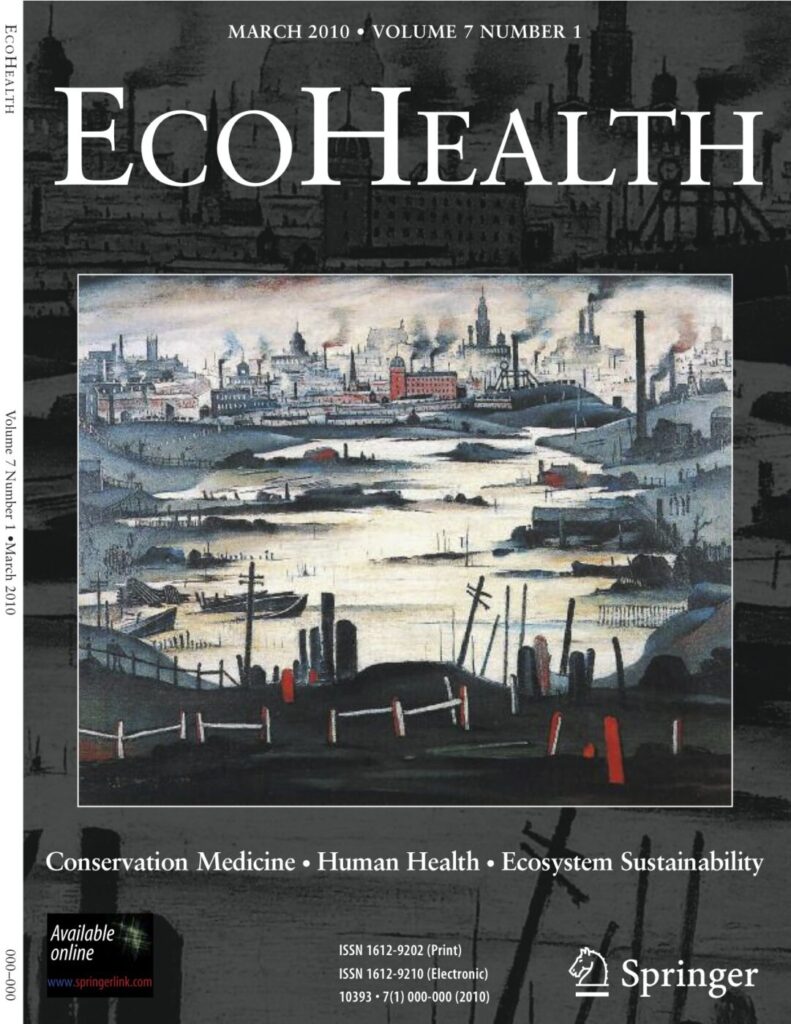
“The Lake” by L.S. Lowry. Cover Essay “My Jerusalem, My EcoHell” by Peter Daszak. EcoHealth 7, 148–149 (2010). https://doi.org/10.1007/s10393-010-0341-y


West Africa, 2014 by Mark Olival-Bartley
EcoHealth’s poet-in-residence, Mark Olival-Bartley, published a particularly poignant piece in honor of the health workers dealing with the Ebola outbreak in West Africa from 2014-16.
Mark Olival. West Africa, 2014. EcoHealth 11 637-638


Palladia, 2023 by Mark Olival-Bartley
In the midst of the most significant pandemic since the 1918-19 influenza, EcoHealth poet-in-residence Mark Olival-Bartley sums up his view of how pandemic politics upended the role of science in our cultural discourse, and revealing how rumor and myth can dominate our otherwise technology- and fact-based lives.


Gallery of EcoHealth Covers
EcoHealth Cover Art is carefully selected to provide cultural context to scientific articles in that issue. Many include a guest essay about the cover, with information on the artist and details on how the image is relevant to our field of science. For full details on each of the beautiful covers below, note down the volume and issue number, and read the relevant cover essay on Springer-Nature’s EcoHealth webpage. For further information, connection to the artists etc., please email info@naturehealthglobal.org